In an op-ed for the Santa Fe New Mexican, co-founder and CEO Charles Cadieu argues that firm federal permitting timelines will help New Mexico build the next generation of low-carbon energy.
For an emerging energy technology, permitting can decide whether a project gets built, where it gets built and how quickly it scales. Spiritus co-founder and CEO Charles Cadieu makes that case in a new op-ed for the Santa Fe New Mexican, backing Senator Martin Heinrich’s Bipartisan American Affordability and Jobs Act.
Meeting rising demand will take every kind of energy the country produces, from wind, solar, geothermal and nuclear to the oil and gas that still supply most of America’s energy. Cadieu argues that New Mexico can lead by showing that low-carbon production serves both economic and climate goals.
Firm deadlines, safeguards intact
Senator Heinrich introduced the bill in October alongside Republican and Democratic committee leaders. It sets hard deadlines for federal environmental reviews: two years for a full environmental impact statement and one year for an environmental assessment. It also protects permits from reversal once they are issued, and it covers carbon capture and storage alongside solar, wind, geothermal and transmission.
Faster decisions do not mean less scrutiny. Environmental review still takes place, Tribal consultation is written into law and projects can still be challenged in court. Cadieu also acknowledges that Tribal nations have raised serious concerns, and that those concerns deserve full consideration as the bill moves forward.
Why it matters for Spiritus
Spiritus’ next step is a larger system in an operating oil field, capturing CO₂ from the air on site so no pipeline is needed. For a young company, time is the tightest constraint. Permits that arrive on schedule and hold once granted let Spiritus build on budget and keep raising the capital to grow. Permits that stall for years risk pushing a technology developed in New Mexico to another state, or stopping it altogether.
The federal timeline carries extra weight in New Mexico, where roughly two-thirds of the state’s Permian oil comes from federal land.
New Mexico has done this before
Cadieu points to the state’s 2021 methane rules, which ended routine venting and flaring. New Mexico’s methane intensity now stands at 1.2%, less than half the 3.1% recorded in Texas, even though output on the New Mexico side of the Permian has more than doubled since 2020. Producers kept investing because they could plan around clear, consistent rules. The bill would bring that same certainty to federal permitting.
Spiritus captures CO₂ from the air at the oil field for enhanced oil recovery, where it is stored underground and measured to federal standards. The result is a lower-carbon barrel from fields New Mexico has already proven, with less pressure to drill in new and more sensitive places. The same technology can also address industrial emissions, including those from data centers.
As Cadieu writes, New Mexico has “the oil, the workforce and a record of smart rules.” The permitting bill gives the state a chance to put all three to work.
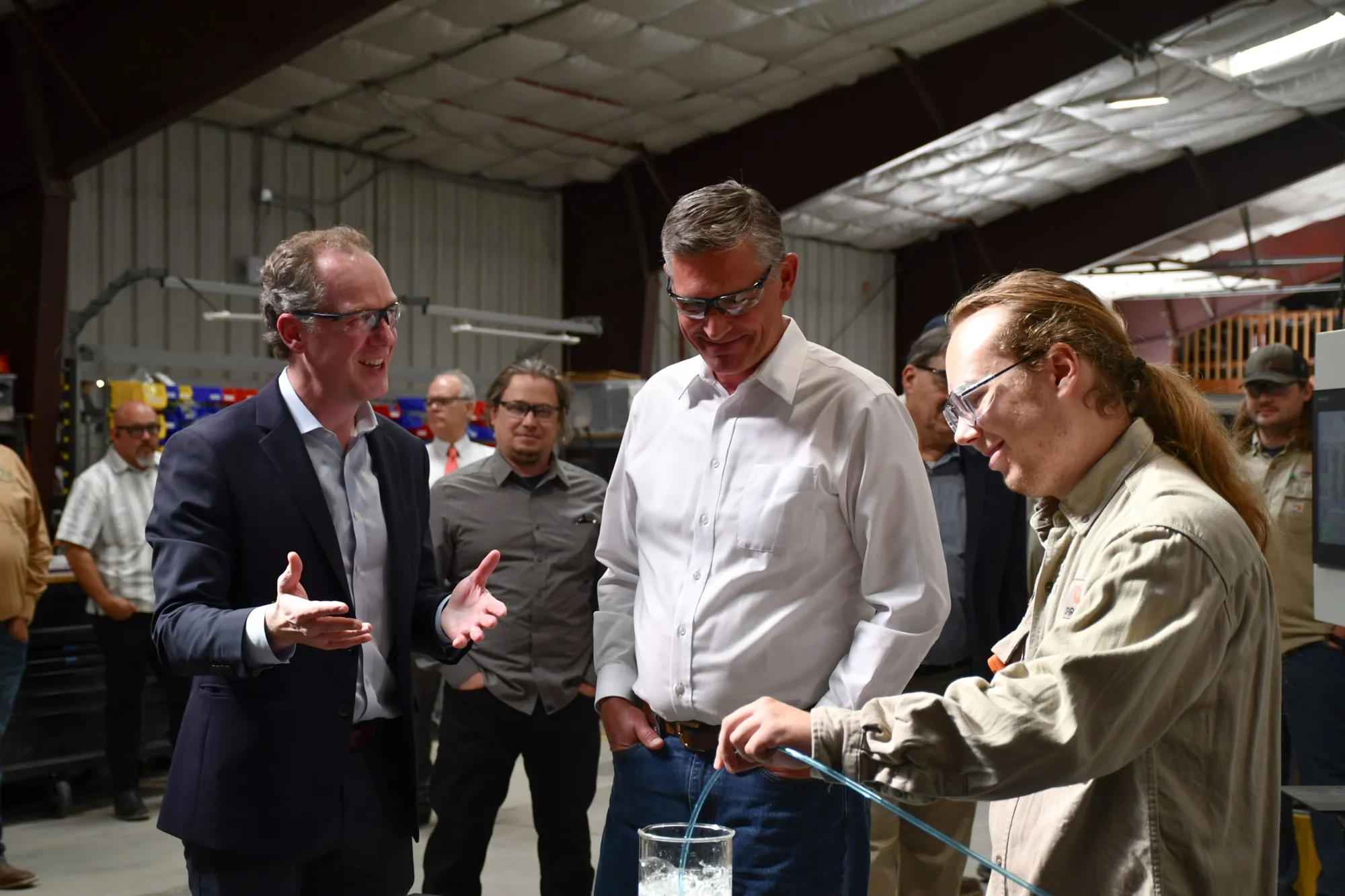
Thank you to Senator Heinrich for his leadership and for visiting our facility at Nambé Pueblo.
Read the full op-ed: Heinrich’s bill will help N.M. lead energy transition | Santa Fe New Mexican